New Collective Set to Explore History of Ards - Newtownards Chronicle
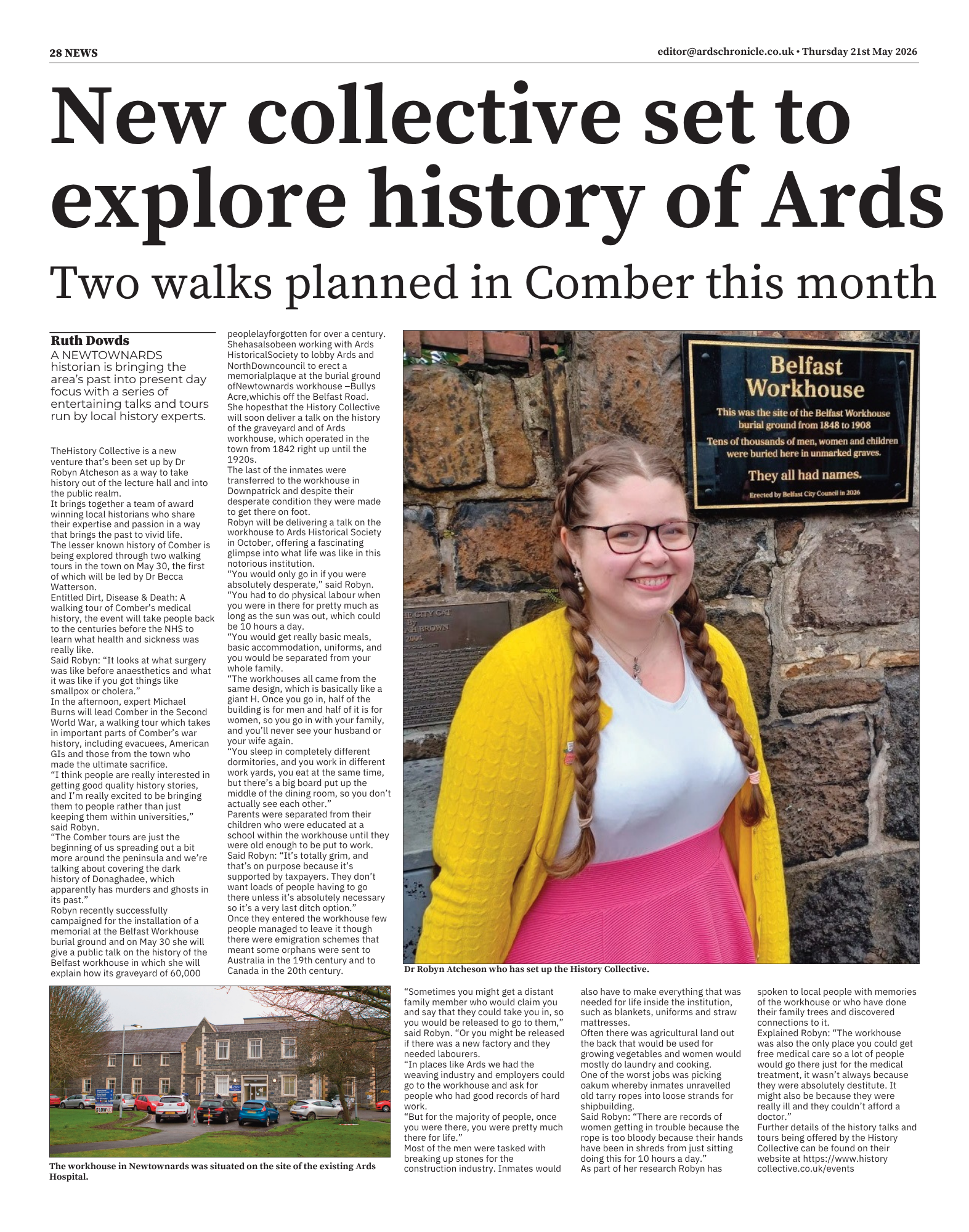
This month in advance of our first events the Newtownards Chronicle were kind enough to run a full-page story about The History Collective
The full text is reproduced below with permission, as the article is not yet on their website for linking.
A NEWTOWNARDS historian is bringing the area’s past into present day focus with a series of entertaining talks and tours run by local history experts. The History Collective is a new venture that’s been set up by Dr Robyn Atcheson as a way to take history out of the lecture hall and into the public realm. It brings together a team of award winning local historians who share their expertise and passion in a way that brings the past to vivid life.
The lesser known history of Comber is being explored through two walking tours in the town on May 30th, the first of which will be led by Dr Becca Watterson. Entitled Dirt, Disease & Death: A walking tour of Comber’s medical history, the event will take people back to the centuries before the NHS to learn what health and sickness was really like. Said Robyn: “It looks at what surgery was like before anaesthetics and what it was like if you got things like smallpox or cholera.”
In the afternoon, expert Michael Burns will lead Comber in the Second World War, a walking tour which takes in important parts of Comber’s war history, including evacuees, American GIs and those from the town who made the ultimate sacrifice. “I think people are really interested in getting good quality history stories, and I’m really excited to be bringing them to people rather than just keeping them within universities,” said Robyn. “The Comber tours are just the beginning of us spreading out a bit more around the peninsula and we’re talking about covering the dark history of Donaghadee, which apparently has murders and ghosts in its past.”
Robyn recently successfully campaigned for the installation of a memorial at the Belfast Workhouse burial ground and on May 30th she will give a public talk on the history of the Belfast workhouse in which she will explain how its graveyard of 60,000 people lay forgotten for over a century.
She has also been working with Ards Historical Society to lobby Ards and North Down council to erect a memorial plaque at the burial ground of Newtownards workhouse – Bullys Acre, which is off the Belfast Road. She hopes that the History Collective will soon deliver a talk on the history of the graveyard and of Ards workhouse, which operated in the town from 1842 right up until the 1920s.
The last of the inmates were transferred to the workhouse in Downpatrick and despite their desperate condition they were made to get there on foot. Robyn will be delivering a talk on the workhouse to Ards Historical Society in October, offering a fascinating glimpse into what life was like in this notorious institution. “You would only go in if you were absolutely desperate,” said Robyn. “You had to do physical labour when you were in there for pretty much as long as the sun was out, which could be 10 hours a day. “You would get really basic meals, basic accommodation, uniforms, and you would be separated from your whole family.
“The workhouses all came from the same design, which is basically like a giant H. Once you go in, half of the building is for men and half of it is for women, so you go in with your family, and you’ll never see your husband or your wife again. “You sleep in completely different dormitories, and you work in different work yards, you eat at the same time, but there’s a big board put up the middle of the dining room, so you don’t actually see each other.” Parents were separated from their children who were educated at a school within the workhouse until they were old enough to be put to work. Said Robyn: “It’s totally grim, and that’s on purpose because it’s supported by taxpayers. They don’t want loads of people having to go there unless it’s absolutely necessary so it’s a very last ditch option.”
Once they entered the workhouse few people managed to leave it though there were emigration schemes that meant some orphans were sent to Australia in the 19th century and to Canada in the 20th century. “Sometimes you might get a distant family member who would claim you and say that they could take you in, so you would be released to go to them,” said Robyn. “Or you might be released if there was a new factory and they needed labourers. “In places like Ards we had the weaving industry and employers could go to the workhouse and ask for people who had good records of hard work. “But for the majority of people, once you were there, you were pretty much there for life.”
Most of the men were tasked with breaking up stones for the construction industry. Inmates would also have to make everything that was needed for life inside the institution, such as blankets, uniforms and straw mattresses. Often there was agricultural land out the back that would be used for growing vegetables and women would mostly do laundry and cooking. One of the worst jobs was picking oakum whereby inmates unravelled old tarry ropes into loose strands for shipbuilding. Said Robyn: “There are records of women getting in trouble because the rope is too bloody because their hands have been in shreds from just sitting doing this for 10 hours a day.” As part of her research Robyn has spoken to local people with memories of the workhouse or who have done their family trees and discovered connections to it. Explained Robyn: “The workhouse was also the only place you could get free medical care so a lot of people would go there just for the medical treatment, it wasn’t always because they were absolutely destitute. It might also be because they were really ill and they couldn’t afford a doctor.”
Further details of the history talks and tours being offered by the History Collective can be found on their website at https://www.historycollective.co.uk/events
News Article by Ruth Dowds of the Newtownards Chronicle